Growing a wildlife garden for bumblebees.
You might question the wisdom of setting up a wildlife garden for just one type of insect and why pick bumblebees out of all the pollinators? Well bumblebees are large, fuzzy and docile; we are familiar with these insects and we know that they are important for pollination. Some species of bumblebees have been in rapid decline and a pesticide free garden with nesting sites might be of some help.
While insects are not exactly the most popular type of animal, there is some fondness for bumblebees. Bumblebees are surprisingly diverse and if you can meet the needs of different species, then you will have a great wildlife garden that helps many other animals to survive. If you do set up a garden for bumblebees, then why not become a citizen scientist with your phone and send in observations?
| |
 |
|
| |
Lawns with some long grass are much more hospitable to wildlife |
|
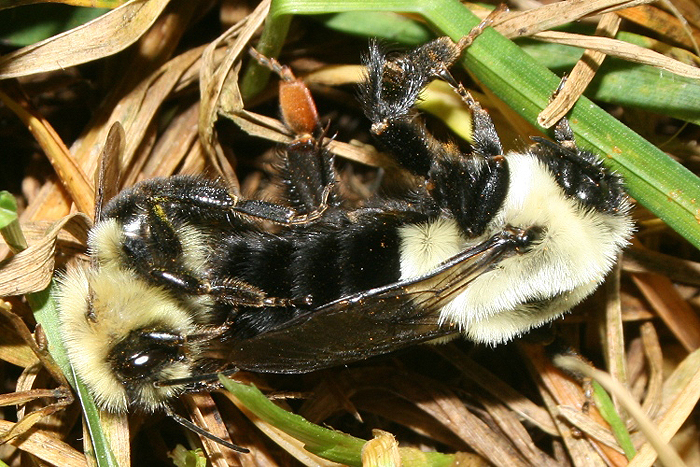
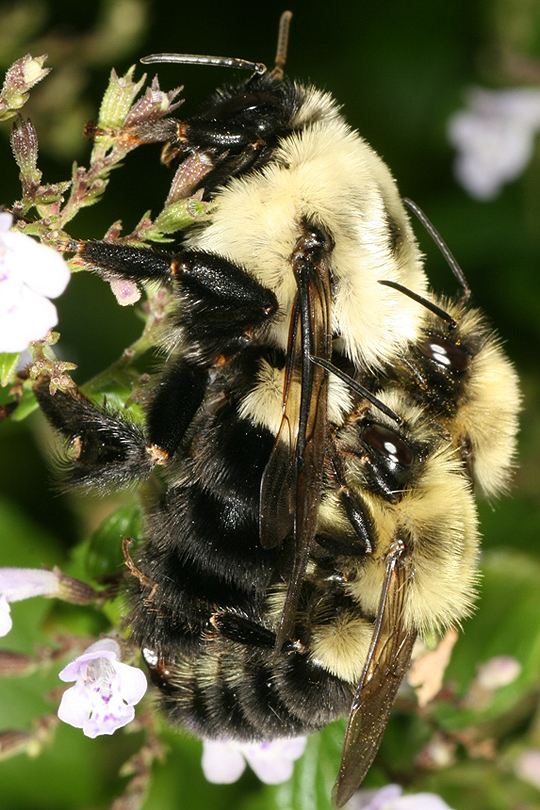
Bumblebees go through a colony cycle. When a queen emerges from her hibernation site in spring, she has to feed and she has to find a site to start her nest. Once she has laid her eggs, the queen has to work even harder to provide food and to keep the nest warm. She has to continue foraging until she has managed to raise enough workers to forage for her. At some point, she will produce new queens and lay unfertilised eggs to produce male drones for the next colony cycle. The new queens have to feed as much as they can to build up an internal supply of fat that will last them through the winter. Before hibernating, a new queen also has to mate with a drone. The males die off in the fall and the new queen will store the sperm to produce fertilised eggs in the spring. She digs a hole somewhere cold and out of view of the sun to hibernate until the spring.
| |
 |
|
| |
2 drones are attempting to mate with a new queen. |
|
Wildlife gardening involves providing both food and shelter. With bumblebees, it is a bit more complicated because these animals need a site to raise their offspring and another site to hibernate through the winter. I once found a bumblebee nest in an old dishwasher left outside a house. Essentially any cavity with some fibre in it could be a potential site, but it is not one size fits all. Some bumblebees nest several feet underground in disused mammal burrows; others nest at or near the surface; and there are other species that will nest in a cavity above ground such as a bird box. Some species produce less than 50 worker bees and can make nests in fairly small spaces while other colonies grow to more than 500 workers. If you want to try making your own box, see here or you can create some cavities at the ground level in your garden. Add some draper's cotton to make the space more enticing.
To aid nesting and hibernation:
Provide areas of your garden where no digging takes place so that holes created by other animals can be reused by bumblebees.
Provide areas where no mowing takes place.
Provide log piles, brush piles or rock piles
Keep areas covered with leaf litter.
Provide an area of unmown bunch grasses. These areas provide cover and they allow insects to dig in between the plants.
Flowers for bumblebees
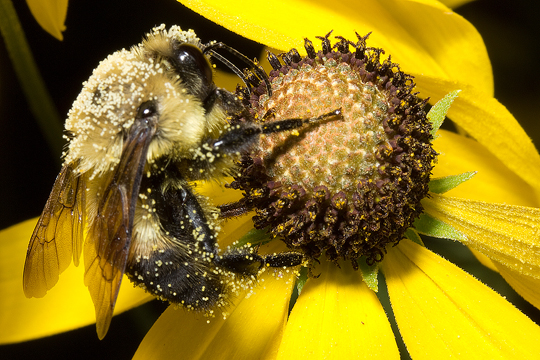
A large range of flowers are needed to provide for various species of bumblebees. They are amongst the first pollinators to emerge and one of the last to become inactive. If you have room, you should provide flowers that bloom from mid spring to early fall. Many of the flowers that bloom early in the season are woodland flowers and trees. These plants usually have a short bloom period. By mid-summer, a lot of perennials are blooming for extended periods in sunnier areas of the garden and the bumblebees are not switching plants so often. At this time, many bumblebee nests reach a population peak. At the beginning of fall, populations are decreasing, but there are still many bumblebees feeding and pollinating flowers. In some cases, the male drones remain alive for several weeks after the colony has completed its cycle. They hang around on flowers like goldenrod in the fall and do not return to the nest at night.
| |
 |
|
| |
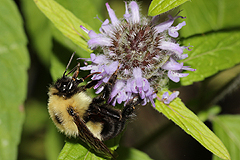
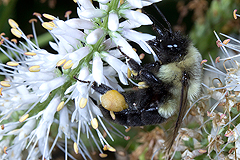
Male bumblebees do not collect pollen. As they move from flower to flower, the pollen clings onto the body hair. Worker bees would comb the hair and store the pollen in pollen baskets. The male in this case is not grooming himself on a regular basis which makes him a great pollinator. |
|
Bumblebees often choose a patch of flowers to obtain nectar and pollen, and they return to the same patch time and time again while the flowers are in bloom. It is recommended to plant flowers in large patches or in repeated drifts. This saves a bumblebee time and energy. Bear in mind that a bumblebee is often travelling up to 2 kilometres to get from the nest to a food source. If you have limited room, avoid trying to plant single specimens of many different species. This would be a design flaw and make the garden ecologically less useful.
| |
 |
|
| |
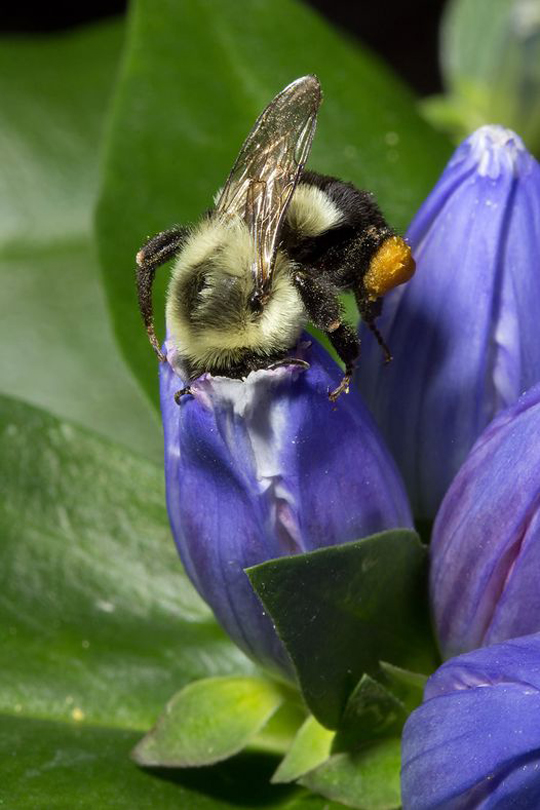
Sometimes, bumblebees have to party or completely force their way into a flower in order to access the nectary. Bottled gentian has closed flowers with a small hole that excludes most pollinators. |
|
Different types of flowers serve different species. Some species are not that robust and need large horizontal flowers like Echinacea. Others can feed vertically on flowers and some are strong enough to hang upside on flowers such as Allium. Like other bees, bumblebees take nectar, which is rich in carbohydrates, and pollen, which is rich in proteins and lipids. The length of the tongue determines which flowers are visited nectaring. Long tongued bees can reach into flowers with deep corollas. It takes longer to visit these flowers, but the nectar rewards are greater. Bumblebees may even push themselves inside the flower to reach the nectary. Short tongued bees need open flowers or they have to drill a hole in the base of a deeper flower in order to reach the nectary. This latter approach is called nectar robbing because it occurs without benefiting the plant.
| |
 |
|
| |
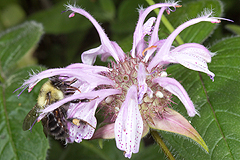
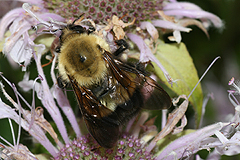
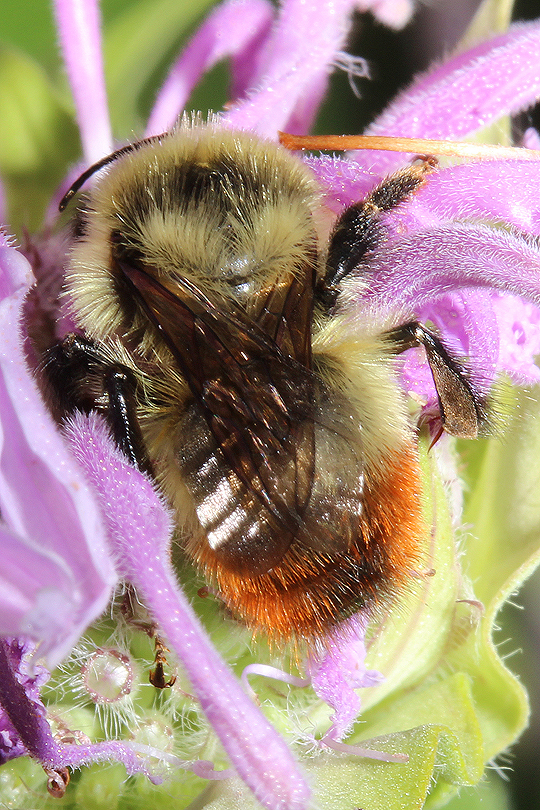
Bombus rufocinctus has a much shorter tongue when compared to other bumblebees. It simply cannot reach down to the nectary of a flower with a deep corolla like Monarda fistulosa. Instead, it can be observed to drill a hole from the outside to access the nectary. |
|
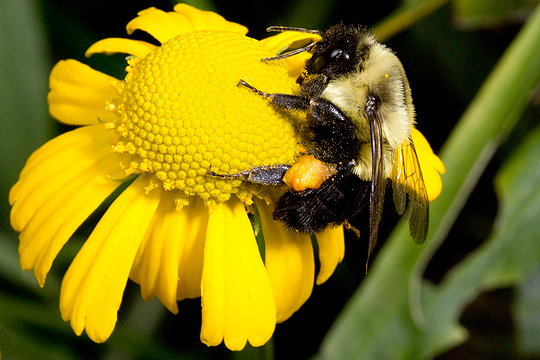
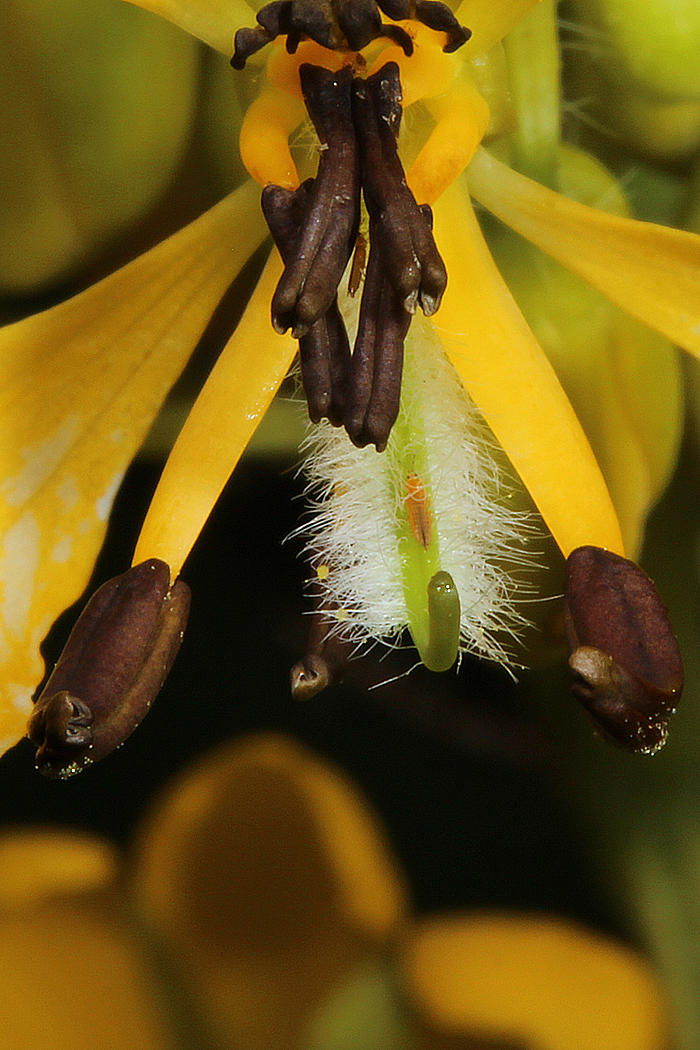
Tongue size do not matter for pollen gathering. It is the structure of the flower that determines how accessible the pollen is. Bumblebees can collect pollen in their body hair just by walking over the flowers, but they also have the ability to extract pollen from poricidal anthers that only release pollen when vibrated at the correct frequency. This is known as buzz pollination or sonication. Bumblebees have some ability to thermoregulate. They do this by the repeated contraction of the wing muscles without actually beating their wings. This produces heat energy that enables bumblebees to work at low temperatures. The same mechanism also allows them to vibrate poricidal anthers to extract pollen. Sonication is an efficient way for the plant to transfer pollen and for the bumblebee to obtain a proteinaceous food source. All pollen collected by queens and workers is removed from the hair and stored in a corbicula on the hind legs.
| |
 |
|
| |
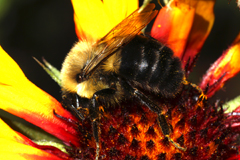
This worker bumblebee has to comb the pollen out of her hair and add it to the pollen baskets (corbicula) on the hind legs. Helenium autumnale, sneezeweed is well liked by bumblebees. |
|
| |
 |
|
| |
These anthers are not covered in pollen. Instead, they have pores on the end of them that release pollen when shaken at the correct frequency. Only bees capable of buzz pollination can access the pollen. The stigma with fuzzy hair is also clearly visible in this picture. As the bumblebees access the anthers to feed, their body hair will touch the tip of the stigma and deposit pollen from other flowers. Wild Senna is fairly popular with bumblebees. |
|
| |
 |
|
| |
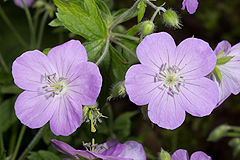
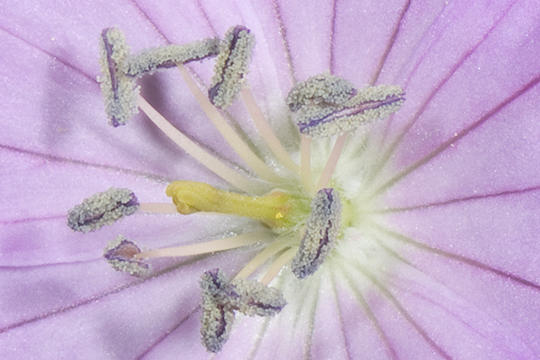
The anthers of wild geranium have accessible pollen on the outside. No sonification is required. |
|
Flowers for spring
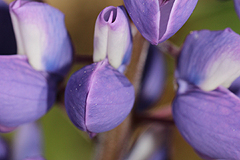
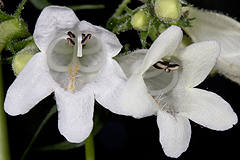
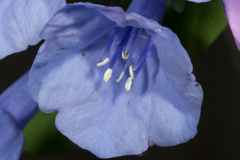
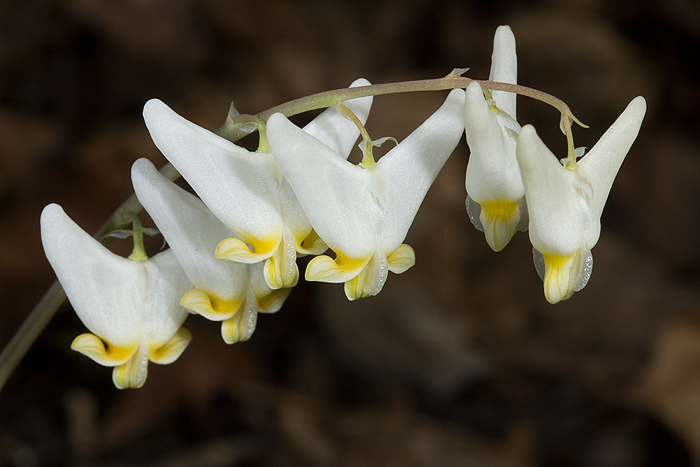
Personal favourites are indicated with a bumblebee icon. While many spring plants are from woodlands and need shade, several of the plants listed here can be grown in full sun with higher nectar yields. Bear in mind that queen bees are much rarer than worker bees, so you should not expect large numbers of bees on plants that flower in mid-spring. The list provides a diversity of flower structures and a diversity of nutritional gifts. Virginia bluebells, Solomons seal and Dutchman's breeches are visited by bumblebees for their nectar in order to get energy. Lupines and penstemons provide high protein pollen that is essential for raising the first brood.
| |
 |
|
| |
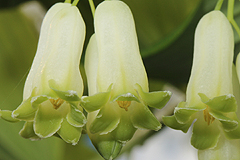
Dutchman's breeches are stunning garden plants, and a bumblebee favourite. |
 |
|
Flowers for summer
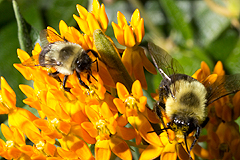
Herbs in the mint family are also popular with bumblebees as they produce a relatively concentrated nectar. While milkweeds do not provide any pollen, many of the summer plants provide pollen rewards which are quite high in protein and are needed to raise new broods of workers as well as queens in colonies with early reproduction cycles. Later on the summer, bumblebees access plants with pollen that is also high in lipids such as Lobelia and Cirsium.
Flowers for fall
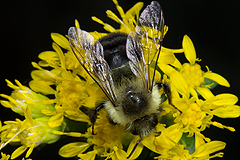
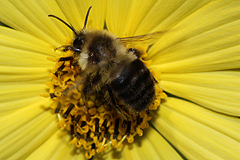
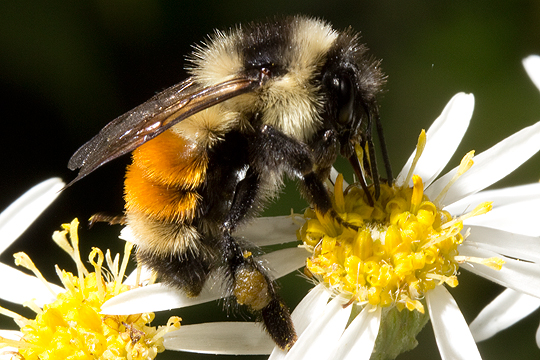
Goldenrods, sunflowers and asters start flowering in August and make up most of the perennials still in flower in the fall. There are a large number of species to choose from and you will almost certainly be able to find some that suit the conditions in your garden. If you want a really long season of blooms, then consider planting heart leaf aster which is one of the last perennials to flower. If you have planted annuals, they may still be in flower as well. The flowers at the end of the season that I have highlighted are all members of the Asters family, which typically have pollen with a lower protein/lipid ratio. The protein values of the pollen are actually still fairly high, but the pollen from these flowers also provide a lot more lipids, which are needed by new queens to build up the internal fat body that helps them make it through the winter. The annual, Gaillardia pulchella, is still in flower in the fall and it too provides a good amount of fat in its pollen. Sunflowers are the exception. They provide lower amounts of protein and fat, but are still essential for bumblebees due to their medicinal value in controlling gut parasites (Adler, 2020). These fall flowers are all key to the survival of bumblebee species.
| |
 |
|
| |
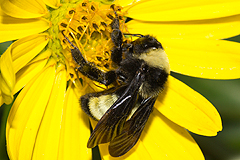
Bombus ternarius has a relatively short tongue, so it commonly observed nectaring on open flowers. Flat topped aster flowers early and you should choose other species to flower in the fall. |
|
Shrubs for bumblebees
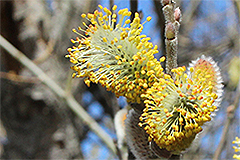
Shrubs can be used in borders to give your garden a vertical dimension. On average, shrubs flower earlier than perennials. Their size results in a large number of blooms that can feed bees. They also provide perches and food for birds. The pussy willow is an early spring flowering shrub. It has special significance in that the pollen is both protein and lipid rich. Queens that are coming out of diapause are energy depleted after a long winter and need to build up energy reserves quickly to find sites where they can start new nesting colonies. Be patient with shrubs as they can take longer to start flowering than many perennials and with trees, you may have to wait over 40 years! If you cannot wait, pick a smaller tree that flowers faster. Aesculus glabra is my favourite, providing a massive nectar and pollen source for queen bees. (See this list of trees for pollinators).
| |
 |
|
| |
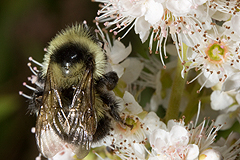
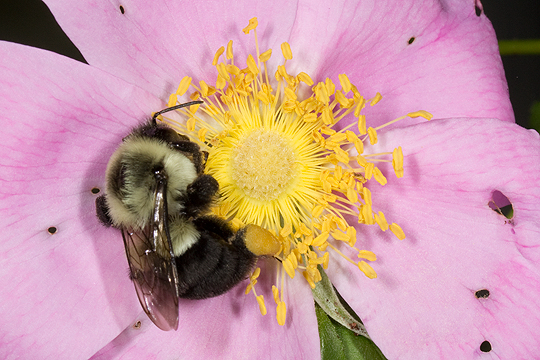
Bumblebees are commonly found on wild roses. English tea roses may look lovely, but bumblebees make it clear which flowers they prefer. The easily accessible anthers provide a large amount of protein in a short period of time. |
|